Mobile app · Lancaster University
Indoor Navigation
An app that finds you inside a building where GPS gives up — using the Wi-Fi that's already there.
- Company
- Lancaster University
- Category
- Mobile app
- Timeline
- Final-year project, 2021 – 2022
- Services
- Mobile app · Location without GPS · Machine learning
THE CHALLENGE
GPS stops working the moment you walk indoors. In a large concrete building, the map on your phone becomes useless at exactly the point you need it — which is why visitors and students kept getting lost across the floors of Lancaster's InfoLab21.
The usual fix is to fit the building with location beacons. They cost money to buy, to install and to keep working, and the university did not want to spend it.
WHAT I BUILT
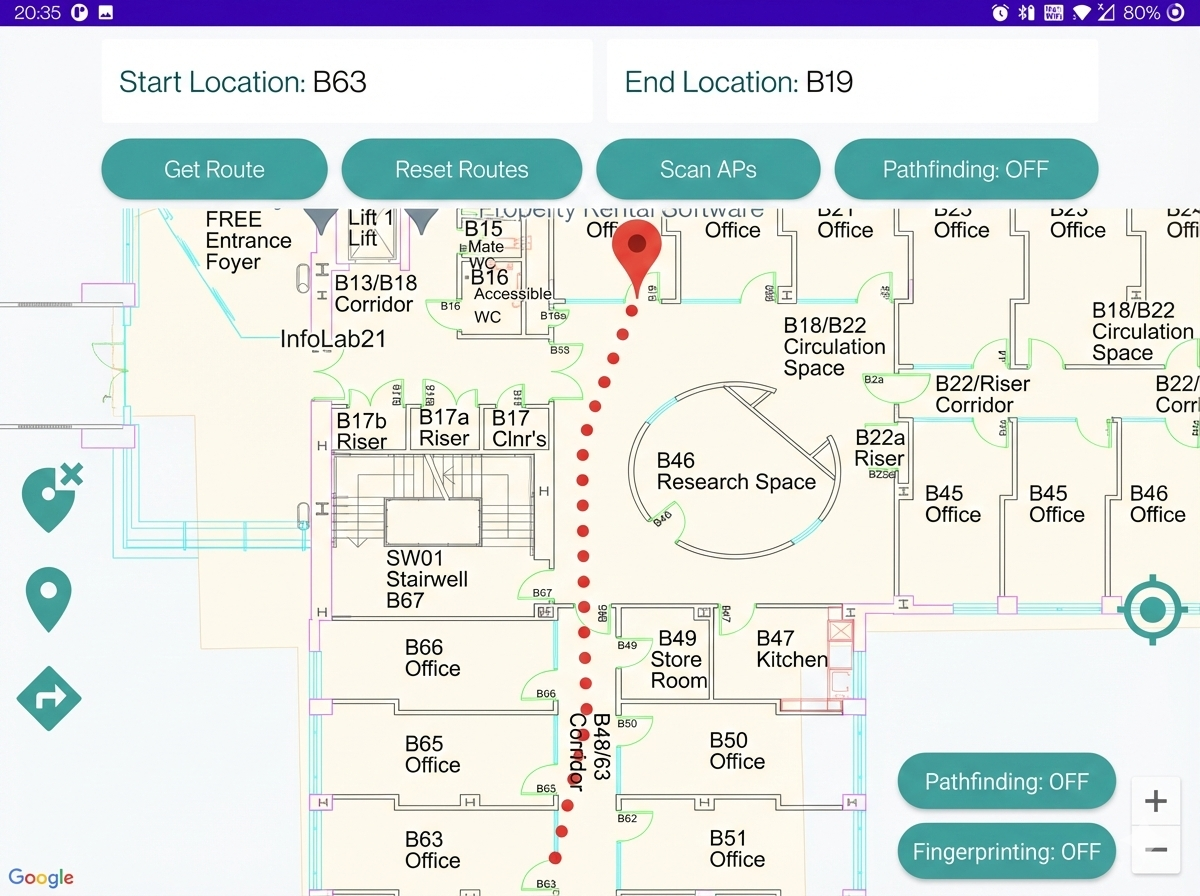
Every spot in a building picks up a slightly different mix of Wi-Fi signal strengths, a bit like a fingerprint. I walked the building recording those fingerprints and built a map of them.
The Android app I built compares what your phone can currently see against that map, works out which recorded spots your position most closely resembles, and places you there.
It locates you to the correct room across several floors, using only the Wi-Fi the building already had — no beacons, no new equipment, nothing to maintain.
The short version
My final-year project at Lancaster: an Android app that works out where you are inside a building, where GPS cannot help. It uses the Wi-Fi already installed, needs no extra equipment, and locates people to the correct room across multiple floors. It was graded A− for technical complexity.
What was at stake
Anyone who has tried to find a specific room in a large university, hospital or office building knows the problem. Outdoors your phone guides you door to door; indoors it gives up.
Solutions exist, but they involve fitting the building with hardware — buying it, installing it across every floor, and maintaining it for as long as you want it to work. For most buildings the cost is the reason it never happens.
Using what the building already has
The idea rests on a simple observation: stand in different places and your phone sees a different combination of Wi-Fi networks at different strengths. That combination is close to unique to a spot, and it is stable enough to recognise again later.
I walked the building recording those readings, building a map of what each location looks like from a phone's point of view.
Turning readings into a position
When someone opens the app, it takes a fresh reading and compares it against everything recorded, finding the handful of locations that most closely resemble what the phone sees now and settling on a position from those.
It is a deliberately simple approach, and the reason it works is quality of data rather than cleverness of method — which is usually where these systems succeed or fail.
Tested in a real building
The app was tested throughout the InfoLab21 buildings, not in a simulation. It reached room-level accuracy across multiple floors, which is the accuracy that actually matters — knowing you are on the third floor is no help if you cannot tell which room to walk into.
Where it landed
- Locates users to the correct room across multiple floors.
- Uses only existing Wi-Fi — no beacons or extra hardware, so nothing to buy or maintain.
- Tested in a real building rather than a simulation.
- Graded A− for technical complexity.
THE OUTCOME
The right room, on the right floor, with nothing new installed.
- Room-level
- Accuracy in real-world testing
- £0
- Spent on extra hardware
- A−
- Grade awarded for technical complexity
Working on something similar?
Tell me what you're building — I'll reply within 8 hours with a free intro call and a fixed quote within 24 hours after our call.
Book a free intro call